Care coordinators were spending 2–3 minutes manually matching medical faxes to patient records a slow, error-prone process with privacy risks. I led end-to-end research and design to transform this into a confident ~60-second workflow.
Team Structure
Role
Timeline
What's the problem?
1
Fax arrives with partial patient info
2
Search returns multiple similar names
3
Manually compare DOB, phone, address info
4
Cross reference profile details in another tab
Mariah (Care Coordinator)
Research & Discovery
8
SHADOWING SESSIONS
12
CONTEXTUAL INTERVIEWS
FULL WORKFLOW MAP
ANALYZED 100+ SUPPORT TICKETS
1
The search fields didn't match the faxes
90% of faxes included a phone number or Health ID — neither was searchable.
2
Disambiguation, not search, was the real problem
Common names returned too many matches — narrowing confidently was the hard part.
3
Anxiety drove behaviour, not speed
Care Coordinators optimized for risk prevention rather than speed.
The constraint
Phone numbers and Health IDs lived in a separate legacy database the system couldn't interpret. Unifying them was a multi-month backend project — design had to work around that, not wait for it.
Exploration
I explored three approaches: search-type dropdown, radio button selectors, and prefix-based search — evaluating each against usability, speed, and engineering feasibility.
Prefix-based search was the clear direction: familiar pattern, minimal backend lift, and it supported both novice and power users without adding friction to every search.
The fix
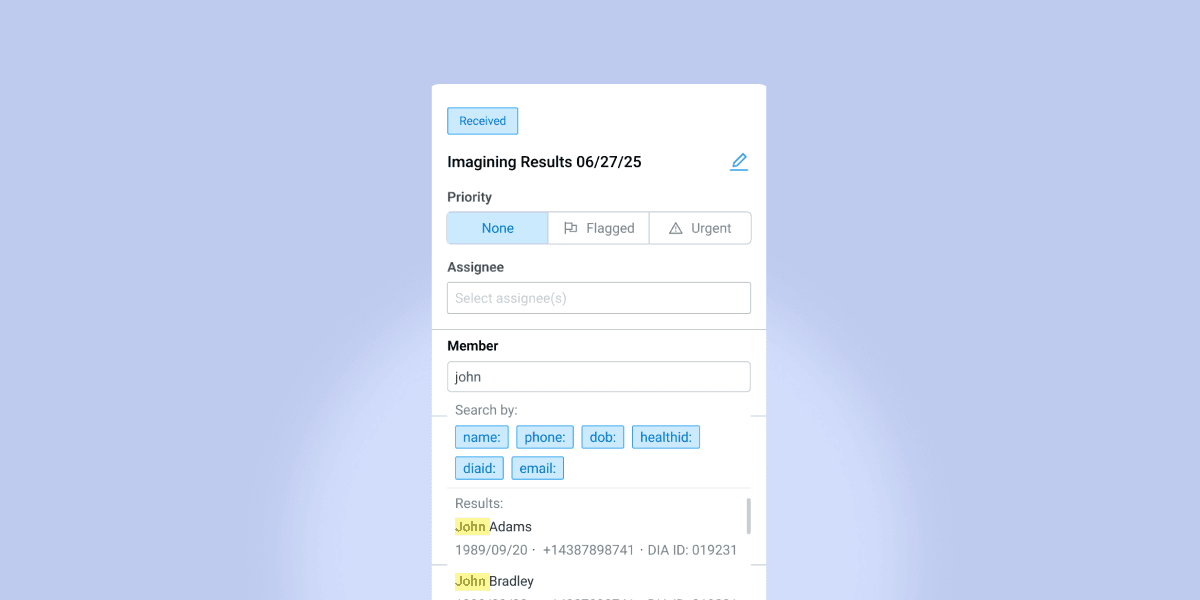
Prefix search with smart match highlighting and stacked filters
phone: 5551234567 - phone search id: AB123456 - Health ID search email: sarah@email.com - email search Sarah Johnson - default name search phone: 555 name: Sarah - stacked filters
Progressive disclosure
Power features for those who want them, simple defaults for everyone else.
Immediate feedback
Every keystroke shows what matched, and why.
Forgiveness over precision
Typos and syntax slips gracefully fall back to standard search.
WHAT I OWNED, END TO END
Interaction specs for every state (empty, typing, results, errors)
Reusable "matched field" highlight component for future search features
Accessibility — screen readers announce matches
Responsive behaviour across desktop and laptop
Full developer handoff with edge-case annotations
"You don't know how amazing this is. Our team is blasting through triaging now."
James (Care Coordinator)
HOW WORK CHANGED
Phone became the #1 search method (85% of searches)
CTMs stopped cross-checking profiles — confidence replaced guesswork
100% adoption within 24 hours, zero critical issues
BUSINESS IMPACT
Faster record matching → quicker clinical decisions
Est. 2–4 hr improvement in urgent referral response
Higher fax volume absorbed with no added headcount
So what's next?
Early OCR tests hit ~95% accuracy for auto-assignment — automation could eventually remove manual triage entirely. Long-term, unifying the databases would let the system auto-detect identifiers with no prefixes at all.


