Automating Leave of Absence Tracking
Doctors were writing the same leave details twice, and clinical ops was interpreting them by hand.
COMPANY
Dialogue
ROLE
Product Designer
TEAM
1 PM, 2 Developers
TIMELINE
4 months
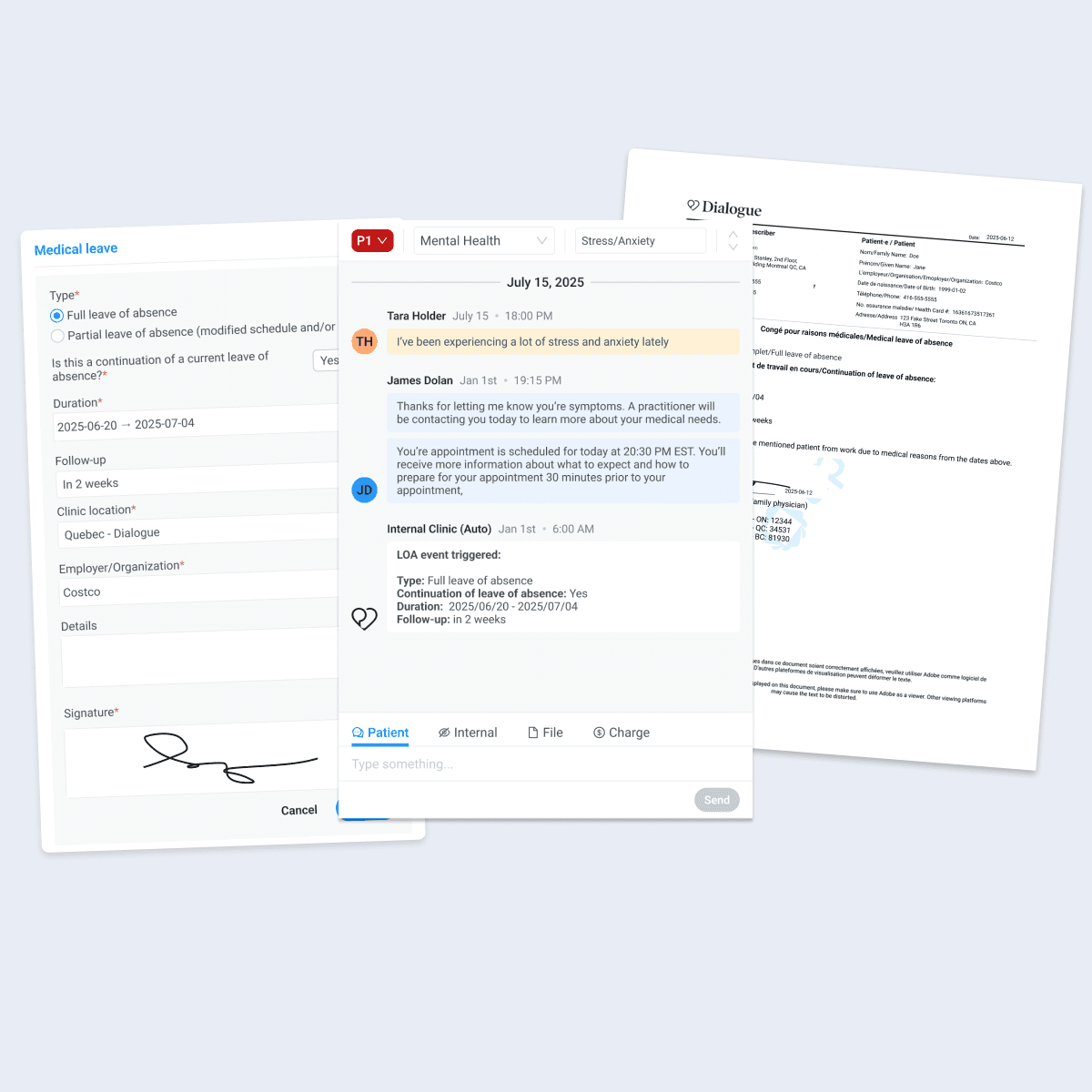
Dialogue medical practitioners had no reliable way to track Leave of Absence prescriptions across Canada. Practitioners documented Leave of Absence (LOAs) inconsistently, care teams manually interpreted every consult note, and enterprise clients received incomplete reporting.
I led UX strategy and design to standardize documentation at the source — turning a fragmented manual process into an automated, scalable workflow that improved outcomes for both clinicians and clinical ops.
~4 hrs/ week
practitioner documentation eliminated
100%
LOAs logged to patient profile
67%
reduction in doctor documentation steps
(from 6 manual actions to 2)
Automated entire Clinical Ops workflow
Enterprise client reporting now based on structured, real-time data
What are we solving?
"There's no reliable way to know what to act on - every practitioner does this differently"
Stephanie m. (M.D)
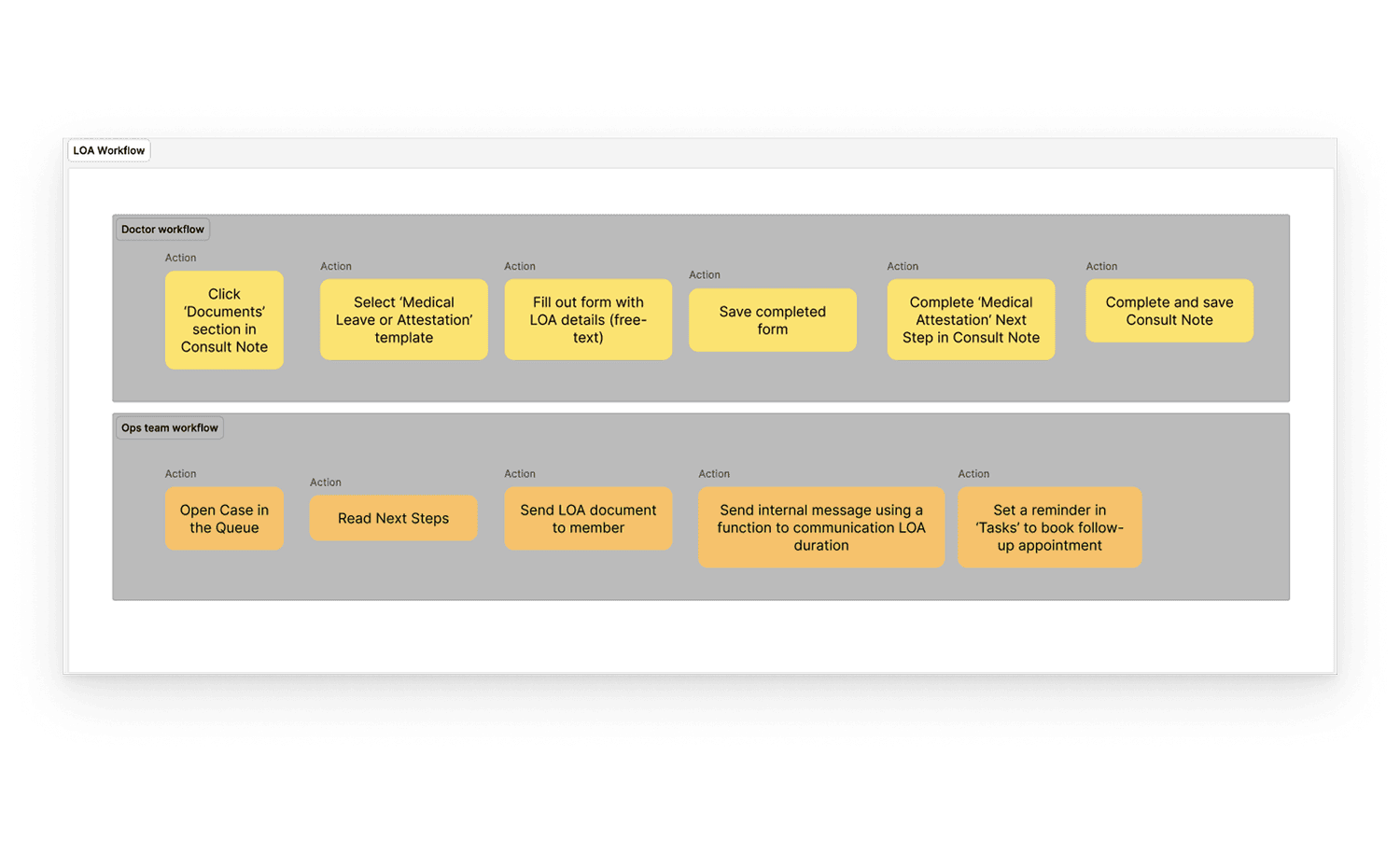
Practitioners prescribed 80–100+ LOAs per week with no standardized process. Doctors filled out a Medical Attestation form, then manually restated the same information in the Next Steps section of their Consult Note; two sources of truth that could easily contradict each other.
From there, Care Team Members (CTMs) had to read and interpret those notes to determine what actions to take, then manually re-communicate context to the rest of the care team via internal message.
Every step in the ops workflow depended on a doctor's free-text note being complete and legible. When it wasn't — and often it wasn't — the chain broke down:
Follow-ups were missed or never scheduled
LOA events went unlogged in the patient record
Client reporting had no reliable data to draw from
Research & Discovery
I initially scoped this as a practitioner-side workflow problem — too many manual steps, too much room for error. But after interviewing 5 physicians and 3 clinical ops members, the picture shifted.
The real problem was upstream: because practitioners had no standardized way to document LOAs, clinical ops had no reliable signal to act on. CTMs had built informal workarounds just to stay on top of active cases — workarounds that weren't scalable and introduced their own inconsistencies.
Key Findings
Practitioners weren't skipping steps out of negligence — the system gave them no structured path to follow
CTMs needed clarity on when to act, not just what to do
The gap between clinical documentation and operational follow-up was the core failure point
This reframed the design problem: it wasn't about fixing a doctor's workflow. It was about creating a shared source of truth that served both sides of the care team.
Solution
The key design decision was embedding a structured inline form directly into the consultation note — mirroring an existing prescription interaction pattern. This kept the workflow familiar for practitioners while eliminating free-text ambiguity entirely.
The doctor's role reduced to two steps: add the Medical Attestation and sign the form. Everything else happened automatically:
Generated the Medical Attestation PDF
Sent the form to the patient via chat
Posted a structured internal message outlining all automated actions
Logged a record in the Medical Attestation table in the patient profile
Sent follow-up appointment availability to the patient

The CTM manual workflow was eliminated entirely. Clinical events were now captured at the source, exactly when they happened, with no interpretation required.
Results & Next steps
Clients could now reliably assess workforce health data. Care teams stopped operating reactively. And the structured event-logging pattern established here is reusable across other clinical workflows at Dialogue.
Natural next steps:
Surface LOA history and status within a patient's profile
Extend the event-logging model to other clinical event types
Deeper employer reporting tied to care outcomes


